Amendment I FREEDOM OF RELIGION, SPEECH, PRESS, ASSEMBLY, AND PETITION “Congress shall make no law respecting an establishment of religion, or prohibiting the free exercise thereof; or abridging the freedom of speech, or of the press; or the right of the people peaceably to assemble, and to petition the Government for a redress of grievances.”
The topic.
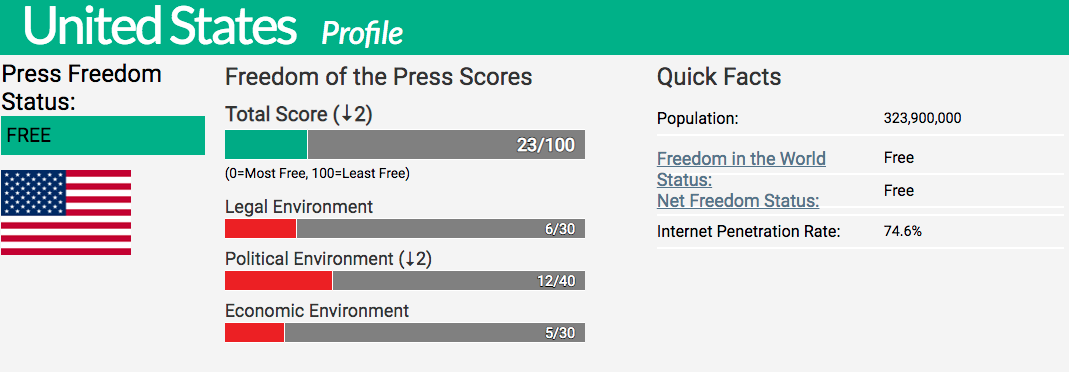
The issue we will look at pertains to current government-set regulations and limitations over the U.S. media. To give us some background, we will look at some data from Freedom House, which breaks down the current freedom status of the press around the globe. According to latest U.S. Freedom of the Press Report, in 2017, the nation’s overall score dropped by two points, specifically when looking at the political environment for the press. An executive summary from the site states that, “The alleged Russian activity contributed to a broader increase in media polarization during the year. Trump supporters accused the mainstream media of bias, and the candidate himself used inflammatory language to denounce the press.”
“The alleged Russian activity contributed to a broader increase in media polarization during the year. Trump supporters accused the mainstream media of bias, and the candidate himself used inflammatory language to denounce the press.”
When we look at media ownership, what we find is that most of the U.S. media companies, with the exception of some public media stations such as NPR and PBS, are privately owned. According to an article, ” by virtue of their source of funding, are a resource for the entire electorate. It is generally accepted that they should not be politically partisan in their editorial coverage. This was the view set out by the UN Special Rapporteur on Freedom of Expression, in his 1999 report, when he spoke of the obligation of the state-owned media to give voice to a variety of opinions and not to be a propaganda organ for one particular political party. Also, they have particular obligations to provide civic education, as well as to provide a platform for the different political parties.”
Cases, Rules and Regulations.
Gitlow vs New York 268 US 652 (1925)
This case involves the publication of a piece by Benjamin Gitlow, a socialist writer who worked for the newspaper called the Left-Wing Manifesto. After the piece’s publication in 1919, Gitlow was charged under the recently passed Criminal Anarchy Law. This law was made after the assassination of former U.S. president William McKinley in 1901. It is also important to note that according to an annotation of the case, “This occurred shortly after the Bolshevik Revolution in Russia, at a time when the U.S. was particularly concerned over the rise of international socialism and communism.” According to an opinion by Justice Edward Sanford, “The Court concluded that New York could prohibit advocating violent efforts to overthrow the government under the Criminal Anarchy Law. Citing Schenck and Abrams, the Court reasoned that the government could punish speech that threatens its basic existence because of the national security implications.”
Gitlow was sentenced to ten years and served two years. The issue brought forth concerned the government’s interference with the piece which was published, and the limitation on the speech which was found as having an anarchist message. The judge in the ruling referenced the decision used in the case, “Schenck v. U.S. A decided 7-2 decision for New York was made, and it was found that there was no sufficient evidence that the publication of Gitlow’s writing could pose an issue. The publication of this piece was found rather abstract and it was found that it would not have an impact considering that it would not have much circulation in terms of readership.
According to an opinion delivered to the court,“…determination must be given great weight…. That utterances inciting to the overthrow of organized government by unlawful means, present a sufficient danger of substantive evil to bring their punishment within the range of legislative discretion, is clear. Such utterances, by their very nature, involve danger to the public peace and to the security of the State.”
Near v. Minnesota, 283 U.S. 697 (1931)
According to the court case, P. 283 U. S. 713., within the means of censorship, “Unless the publisher is able and disposed to satisfy the judge that the charges are true and are published with good motives and for justifiable ends, his newspaper or periodical is suppressed and further publication is made punishable as a contempt.”
“This court case was a landmark for what is known now as prohibitions on prior restraint or government censorship towards the press.”
In my opinion, the case was fairly tried. Further, the points of safeguarding the press, which were not necessarily part of the case but within the bigger picture of freedom of the press, are more principal. The question brought forth was whether giving the press the freedom to rightfully publish information which could be found false is fair is also answered within the context of this case. According to the text, “Public officers find their remedies for false accusations in actions for redress and punishment under the libel laws, and not in proceedings to restrain the publication of newspapers and periodicals. P. 283 U. S. 718.”
The court found that, “Liberty of the press is within the liberty safeguarded by the due process clause of the Fourteenth Amendment from invasion by state action. P.283 U. S. 707.”
In New York Times Co. v. United States, we see that in light of confidential information from the War being exposed, the publication of reporting from said government records jeopardized the stance of the newspaper. What the paper found as timely news was criticized as news which should have been censored by the government.
Although the court found that the newspaper had fairly reported on the Watergate scandal, there were still hesitations towards who was right and the power of the press was questioned.
Turner Broadcasting System, Inc. vs FCC (1944)

According to the 1992 Cable Television Consumer Protection and Competition Act, a cable broadcaster must have time set aside for local programming. According to sections 4 and 5 of this act, cable news or broadcast on air systems must allot a portion of their programming to local programs.
The issue was brought forth after concern over the potential compromise between the competition of cable news and on-air broadcast news networks. The 5-1 decision held that Congress has interest in overseeing the competition amongst broadcasters.
Further it was found that, “the must-carry obligations may be broader than necessary to protect vulnerable broadcasters, but that would not, alone, be enough to demonstrate that they violate the First Amendment. Thus, for instance, to the extent that 4 and 5 obligate cable operators to carry broadcasters they would have carried even in the absence of a statutory obligation, any impairment of operators’ freedom of choice, or on cable programmers’ ability to secure carriage, would be negligible.”
Further Considerations.
New York Times v. United States & Snepp v. United States
Americans, without a doubt turn to their local broadcasters and nationally acclaimed media outlets to stay updated and consume news content, yet one consideration is whether or not the information journalists are given through public records is comprehensive and thorough. In recent conversation, access to confidential information has stirred up controversy. The Constitution Center further looks into the precautions of leaks of classified information. The U.S. supreme court held in New York Times v. United States that unless there is a danger of national security, the government has no constitutional right in prohibiting the publication of this information.
According to a syllabus on Page 403 U. S. 714, “In my view, far from deserving condemnation for their courageous reporting, the New York Times, the Washington Post, and other newspapers should be commended for serving the purpose that the Founding Fathers saw so clearly. In revealing the workings of government that led to the Vietnam war, the newspapers nobly did precisely that which the Founders hoped and trusted they would do.” As we have seen, the actions of the newspapers were further justified for exceptionally exposing the government. The free press has the right to expose unethical government actions which would remain otherwise hidden from the public. But, some of the debate around this issue deals with what the future could hold for journalists reaching too far into their role of watchdogs.
According to the same syllabus, only a free press could expose government deception or a government withholding information. Meaning, both of these matters go hand in hand. In a report by Geoffrey Stone, a professor of law at the University of Chicago, another point brought forth was whether in the future government workers themselves who provide deceptive information would be afforded the same protective rights journalists have. According to the article by Stone, “At the same time, though, the Court has held that government employees who gain access to such classified information can be restricted in their unauthorized disclosure of that information. Snepp v. United States (1980).”
Current Affairs.
Journalists exposing government officials…
A recent report by the New York Times explains the plea agreement made between the Presidents former campaign chairman Paul Manafort and the Special Counsel Committee. Within the report they reference a recent article released by the Guardian which exposed new information on the investigation stating that Mr. Manafort made secret visits to the Ecuadorian embassy in London.
The NYT states that they do not believe information within the report was information known to the Special Counsel Committee. Since these visits occurred amidst the WikiLeaks scandal, the report also states that the exposure of this information will lead to more investigation of these visits. According to the report, the story published by the Guardian suggests that there is information being omitted from the public, which make this story bigger than what it is.
In my opinion, journalists should continue to report honestly with hopes of giving audiences information they can then use to make their own decisions. Evidently, the release of classified information will affect the future of political campaigns, something seen during the 2016 election. In terms of how the courts will view cases involving the release of sensitive information, this is a grey area that will continue to develop. The standards of the free press within the U.S. may be in compromise as this conversation continues to develop.
Photograph and animation by Cecilia Lemus
 First Amendment Issues